
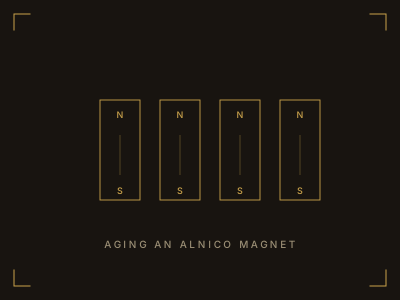
Alnico 2 bar magnets, partially de-gaussed for a softer field.
June 20, 2026 · Basement Pickups · 5 min read
Aging an Alnico Magnet
What sixty years of charge loss does to a pickup — and how to honor it.
Alnico is one of those materials whose name is just its recipe read aloud: aluminum, nickel, cobalt, with iron and a few other elements making up the balance. Cast or sintered into a bar and then magnetized, it became the standard permanent magnet for guitar pickups in the 1950s and never really left. Alnico 2, alnico 3, alnico 4, alnico 5, alnico 8 — the numbers refer to different alloy mixes with different magnetic strengths and characters. They are the heart of a pickup's voice, and like any heart, they change with age.
The thing players notice about genuinely old pickups is that they often sound softer, sweeter, and more dynamic than a brand-new pickup built to the same spec. There are several reasons, but one of the most important is simple physics: the magnet has lost some of its charge. A magnetized piece of alnico does not hold its full field forever. Over decades, exposure to heat, to stray external fields, to physical shock, and to the slow internal relaxation of the material itself all nudge the magnet toward a lower state of magnetization. It does not become useless; it becomes weaker. And weaker, in a guitar pickup, is frequently more musical.
To understand why, think about what the magnet is doing. It magnetizes the steel parts of the pickup and the strings above it, and as the strings vibrate they disturb that magnetic field, inducing a voltage in the coil. A stronger magnet senses the strings with more authority: more output, yes, but also a firmer magnetic "pull" on the strings themselves. That pull is real and audible. Set a strong pickup too close to the strings and you can hear it fight the vibration — reduced sustain, a slightly stiff or warbly response, intonation that wanders on the lowest strings. A weaker field exerts less pull. The strings move more freely, sustain opens up, and the pickup's response loosens.
There is a compression effect too. A weaker magnet senses small string motion less aggressively and lets large string motion bloom against a softer ceiling, so the dynamic curve becomes gentler at the top. The pickup feels like it has a little natural give. Combine that with the slightly lower output and you get the classic vintage feel: a pickup that cleans up easily, compresses sweetly when pushed, and never sounds brittle. None of this is mystical. It is the predictable result of a magnet sitting in a guitar case for half a century.
The obvious question follows: if a partially discharged magnet sounds good, can we get there without waiting sixty years? We can, carefully. The process is usually called aging or, more precisely, partial degaussing — deliberately removing some of the magnet's charge in a controlled way. The crude version is to bring an opposing magnet near the bar and knock the field down, but that is imprecise and easy to overshoot. The better approach uses a calibrated alternating field, gradually reduced, to bring the magnet down to a target strength, or a measured DC field applied against the magnet's polarity in small, checked steps.
The key word is measured. A gaussmeter turns this from guesswork into a repeatable process. We read the magnet's surface field before we start, decide on a target — a percentage of full charge that suits the voicing we are after — and step the magnet down toward it, re-measuring as we go. Take off too little and you have done nothing audible; take off too much and the pickup goes limp and lifeless, with weak output and a vague, undefined low end. There is a window, and it is different for each alloy and each design, which is why notes and a meter matter more than folklore here.
It also matters which alnico you start with, because the alloys do not respond identically and they do not start in the same place. Alnico 2 is already a softer, lower-field magnet with a warm, slightly compressed character, so it often wants only a gentle touch. Alnico 5 is stronger, tighter, and more focused, with a firmer low end and more aggressive top, and aging it can tame that edge into something rounder. Alnico 8 is stronger still, dense and punchy, and a measured reduction can keep its power while pulling back some of its stiffness. The goal is never to make every magnet weak; it is to place each one where it flatters the coil it sits under.
Aging asymmetrically is a subtler trick worth mentioning. Real vintage magnets did not lose charge perfectly evenly along their length, and there is character in that. A magnet that is slightly stronger under one coil than the other shifts the balance of the pickup in small ways that can add life, much as coil mismatch does in a PAF. It is a fine adjustment, easy to overdo, and only worth attempting once the basics are under control.
What all of this honors is a simple truth: a pickup is a system, and the magnet is the part of that system that quietly drifts over time. Pretending a fresh pickup will sound like a sixty-year-old one straight off the bench is wishful thinking — the magnet is at full charge, and full charge has a sound. Aging the magnet, deliberately and by measurement, lets us deliver some of that hard-won vintage character now, without asking a player to wait out the decades. Done with restraint and a meter, it is not a gimmick. It is just acknowledging that the best-sounding magnets in history were, every one of them, a little bit tired.